
The Nain Rouge: The Watcher in Red
“Folklore recorded the timing correctly. History misunderstood the intent.” - Jacob R. Kosinski
As Recorded in the Old Accounts
Long before Detroit became a city of steel, smoke, and streetlights, stories circulated among settlers, traders, and laborers of a small red figure seen moving at the edges of civilization.
Early written accounts, drawn from French colonial records, personal journals, and later folklore collections, describe a dwarfish man dressed in red, appearing suddenly and vanishing just as quickly. He was said to laugh, gesture, or glare, often just before moments of misfortune. Floods. Fires. Failed harvests. Riots. Military defeat.
By the 18th and 19th centuries, these sightings hardened into reputation.
The Nain Rouge was labeled a curse.
Books compiled in the late 1800s and early 1900s describe him as a demon, a trickster, a malevolent spirit tied to the land, an omen of ruin that followed Detroit wherever it grew. The pattern seemed obvious to those recording the stories: he appeared, then disaster followed.
What these early chroniclers did not attempt to answer was why.
Witness descriptions were strikingly consistent. The figure was small, hunched, and carried a crooked staff or cane. He was often seen at night or in poor weather, and many reported glowing eyes shining through mist or rain. Over time, these details were embellished, repeated, and sensationalized, transforming the Nain Rouge from a folkloric figure into a symbol of fear.
Yet even within these fearful accounts, one detail remains quietly persistent:
The Nain Rouge never attacked anyone.
He never caused the destruction attributed to him.
He never spoke threats.
He simply appeared.
The Watcher’s Light
The lantern he carries, long mistaken for glowing eyes, is believed to be a reclaimed relic from Detroit’s rail yards and industrial corridors.
In the archives, it is known as:
The Watcher’s Light
Recovered near Fort Street Station, Detroit. A signal meant to be seen, not fled from.
The lantern’s purpose is simple: to warn, to mark a moment, to say pay attention. Its light does not cause disaster. It arrives when disaster has already been set in motion.
Kosinski’s Final Confirmation
In the late 1930s, as naturalist and researcher Jacob Kosinski neared the end of his life, the Nain Rouge came to him, not as an omen, but as a quiet visitor.
On a rain-soaked night, the Nain Rouge spoke plainly.
He told Kosinski that the cryptids were guardians, not monsters. That humanity had begun to lose the ability to recognize warnings. And that a great darkness was approaching, not from creatures, but from people.
He did not stay long. He did not answer every question. And he did not return.
Kosinski understood this for what it was: a gift, not to be chased, recorded, or exploited.
Legacy
Within the Michigan Cryptid Arcane, the Nain Rouge stands as a symbol of a difficult truth:
Warnings are only useful if someone is willing to listen.
He does not cause disasters.
He does not seek attention.
He simply shows up when it matters.
And when he is seen, something has already gone wrong. We shouldn’t blame the messenger.

The Misreading of a Warning
Within the Michigan Cryptid Arcane, these early records are notdismissed, but reinterpreted.
The timing was real.
The fear was real.
The conclusion was wrong.
The Nain Rouge did not bring calamity. He arrived because it was already coming.
The glowing “eyes” described in the old books were not eyes at all, but a lantern, carried on a crooked staff, its yellow light cutting through fog, smoke, and rain. A warning light mistaken for menace. A signal meant to draw attention, misread by generations unwilling to stop and listen.
As Detroit grew louder, faster, and more confident, warnings became easier to ignore, and easier to blame.
History recorded the Nain Rouge as a villain.
The Watcher in Red
In the Michigan Cryptid Arcane, the Nain Rouge is understood not as a demon, but as a guardian, one of the oldest watchers to walk the land that would become Michigan.
Small in stature and dressed in red, he moves quietly through cities, rail yards, and forgotten places. He carries a lantern mounted on a hooked staff, its glow steady and deliberate. To frightened witnesses, the light appeared as something unnatural. To those who understood, it was a warning, not of his making, but of what lay ahead.
He appears at moments of imbalance: before disasters, upheaval, or great human missteps. He does not interfere. He does not prevent what must unfold. His role is to observe, remember, and warn.
Guardian of the Cryptids
Among the cryptids documented within the Michigan Cryptid Arcane, the Nain Rouge is the oldest. He is a historian, messenger, and quiet protector, not just of cities, but of cryptid-kind itself.
Where younger cryptids act on instinct, the Nain Rouge acts on memory. He understands patterns, cycles, and consequences. He is not feared by the other cryptids. He is respected.
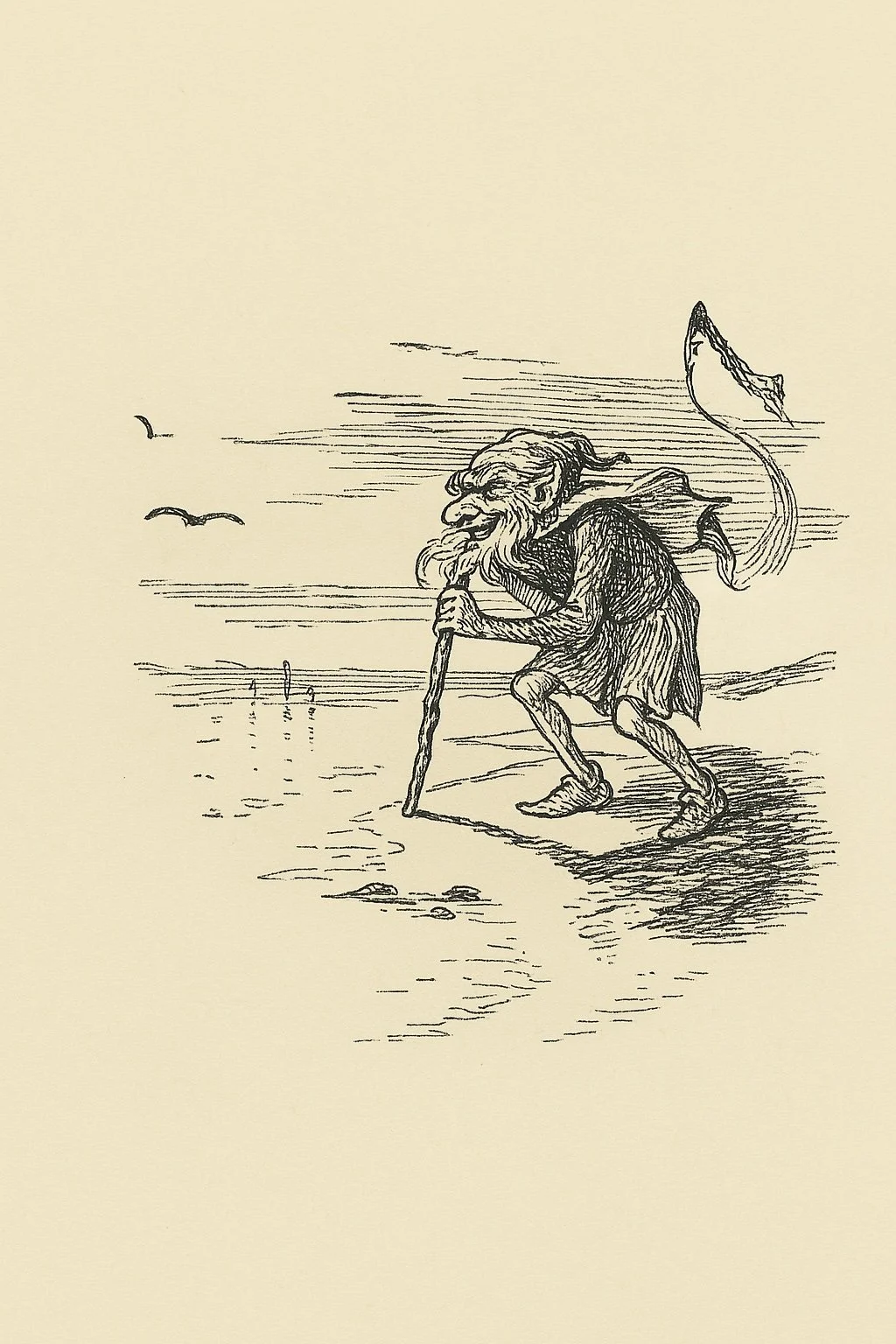
Illustration from Legends of Le Détroit (1884), Marie Caroline Watson Hamlin — public-domain folklore collection documenting early Nain Rouge accounts

Historical References
· Legends of Le Détroit (1884), Marie Caroline Watson Hamlin — public-domain folklore collection documenting early Nain Rouge accounts
· 18th–19th century French colonial oral traditions preserved in regional folklore
· Detroit-area historical retellings and early 20th-century folklore compilations
The Sources form the foundation upon which the Michigan Cryptid Arcane reexamines the legent of the Nain Rouge